
Key Takeaways
- Strong fine motor skills before age 5 make writing, cutting, drawing, and self-care tasks like zipping, buttoning, and using utensils much easier once kindergarten starts. Children who build these abilities early transition more smoothly and with greater confidence.
- Fine motor skills and gross motor skills develop together. Children who struggle with hand and finger tasks often tire quickly in kindergarten and may begin avoiding early academic work out of frustration.
- Most fine motor developmental milestones fall between ages 2 and 5, making the preschool years-especially ages 3 to 4-a critical window to develop fine motor skills through play.
- Parents and early childhood teachers can build these skills at home and in preschool with simple, low-cost activities like playdough, bead stringing, tweezers, blocks, and pre-writing games.
- At Adventure Learning Center in Ballwin, Missouri, intentional fine motor practice is built into daily preschool and Pre-K routines to support school readiness.
Introduction: Why Fine Motor Skills Matter Before Kindergarten
Picture a typical first day of kindergarten in August. Children are asked to write their names on a piece of paper, cut along dotted lines, open snack containers, and hang their backpacks on hooks. Every one of those tasks relies on fine motor skills-the small, coordinated movements of the hands and fingers used for writing, drawing, cutting, buttoning, and manipulating small objects.
Many kindergarten expectations today assume children have already built basic hand strength and coordination during early childhood. Teachers expect kids to hold pencils, use glue sticks, and manage their own belongings with reasonable independence. When children arrive with these skills in place, the transition is smoother, their confidence is higher, and frustration stays low.
This article covers what fine motor skills are, how they differ from gross motor skills, the key developmental milestones between ages 2 and 5, practical activities for home and school, and when it may be time to seek extra support.
Fine Motor Skills vs. Gross Motor Skills: How They Work Together
Fine motor skills use smaller muscles in the hands and wrists to perform precise tasks. Gross motor skills involve larger muscle groups-shoulders, arms, legs, and core-for whole-body movement. Both categories of motor skills are essential to child development, and they do not develop in isolation.
Fine motor examples: picking up a Cheerio with a pincer grasp, turning book pages, holding a crayon with three fingers, using scissors, building with small blocks, fastening a zipper.
Gross motor examples: crawling, walking, jumping, climbing stairs, throwing a ball, riding a tricycle. These are the gross motor milestones pediatricians often check at well-child visits.
Fine motor skills develop after gross motor skills in infants. A child’s gross motor skills-stable shoulders, a strong core, and good balance-provide the foundation that allows the hands to do precise work. In quality child care and preschool programs, both fine and gross motor activities are intentionally planned each day rather than treated as separate priorities.
What Are Fine Motor Skills in Early Childhood?
In early childhood, fine motor skills are the precise movements children use from ages 2 through 5 to explore toys, complete self-care, and begin pre-writing and early academic tasks. Developing fine motor skills builds hand strength, finger control, and eye hand coordination-the building blocks for nearly everything a preschooler does with their hands.
Everyday preschool tasks that rely on these skills include:
- Stacking blocks and nesting cups
- Stringing beads onto a shoelace
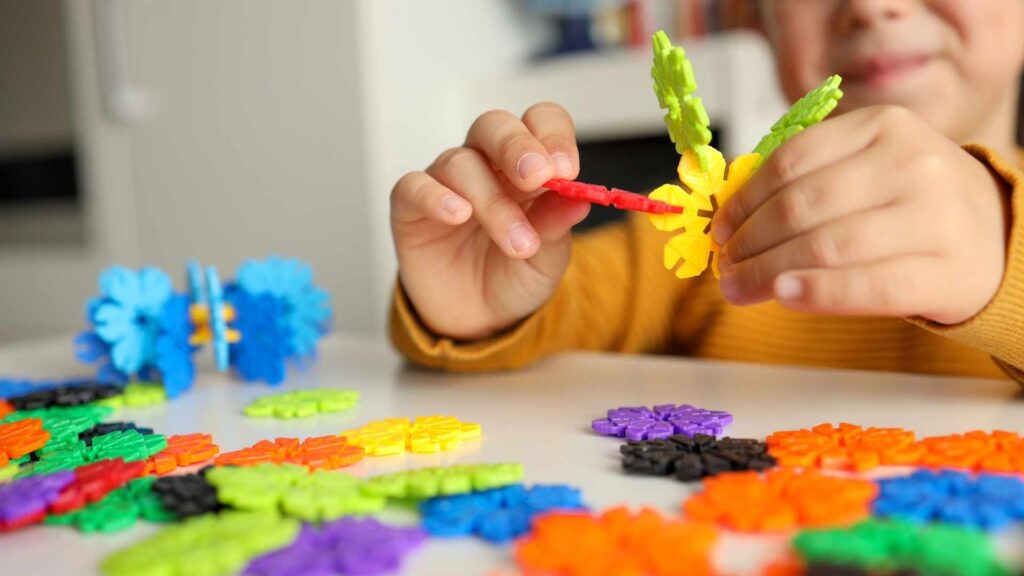
- Building with interlocking bricks
- Using stickers and doing simple puzzles
- Turning pages during story time, which supports hand strength and coordination
- Children can improve fine motor skills by manipulating small toys during free play
School-related tasks are equally dependent on these abilities. Handwriting and drawing require finger control, wrist stability, and proper grip. Tracing shapes, coloring within boundaries, gluing small pieces, and beginning to form letters and numbers all demand precision. Fine motor skills help preschoolers participate confidently in play and in structured learning activities alike.
Self-help examples matter for kindergarten readiness too: pulling up pants, fastening snaps or large buttons, opening lunch containers, brushing teeth with some independence, and using utensils during meals all enhance fine motor skill development. Good fine motor control also supports early technology use, like tapping and dragging on a touchscreen, which increasingly appears in kindergarten classrooms.
Why Fine Motor Skills Are So Important Before Kindergarten
Fine motor skills are not just about neat handwriting. They impact how comfortably and confidently a child can participate in nearly every part of the kindergarten day. Fine motor skills support children’s ability to participate comfortably in learning activities, from morning circle to afternoon art.
Academic impact. Fine motor skills can influence academic learning in literacy and mathematics. A 2025 meta-analysis of 118 studies and nearly 80,000 children found a moderate but meaningful correlation (r = 0.329) between fine motor abilities and academic-cognitive skills. Research links fine motor competence to stronger reading and math outcomes. When children can control their pencils and scissors without struggling, cognitive load decreases and their attention shifts to learning letters, numbers, and concepts.
Emotional and social impact. Children who can manage their own zippers, lunch items, and classroom materials tend to feel more competent, ask for less adult help, and participate more with peers. Competence in fine motor skills promotes children’s self-esteem. Fine motor skills influence emotional and social development in ways that ripple through a child’s school experience.
Stamina. Weak hand muscles lead to quick fatigue during coloring, tracing, or writing. This can cause avoidance behaviors or negative attitudes toward schoolwork even in the early years.
Long-term development. Fine motor skills are critical for early academic readiness. Fine motor development is closely linked to cognitive and executive function growth. Mastery of fine motor skills accelerates children’s independence and prepares children to take on increasingly complex tasks in elementary school and beyond.
Typical Fine Motor Developmental Milestones (Ages 2–5)
Every child develops at their own pace, but developmental milestones give parents and teachers useful age ranges to watch. Here is a general progression most children follow:
| Age Range | Milestone Examples |
| 12–18 months | By 12–14 months, children can use a pincer grasp. By 15–18 months, children can stack 2–3 cubes. Stacking 2–3 cubes helps develop fine motor skills in toddlers. |
| 19–24 months | At 19–24 months, children can draw vertical lines. Babies and toddlers begin using a spoon and turning thick pages. |
| 2–3 years | At 2–3 years, children can stack 8–10 cubes, scribble with purpose, and start using a fork. |
| 3–4 years | By 3–4 years, children can use scissors to cut a straight line, copy simple shapes like circles, string large beads, and begin snipping with safety scissors. |
| 4–5 years | Holding a pencil with a developing tripod grasp, cutting along curved lines, drawing a basic person with facial features, and writing some letters of their name. |
These milestones are based on guidelines from the American Academy of Pediatrics. Fine motor progress is often closely linked with increasing independence in self-care tasks like dressing and feeding during the preschool years.
Families who notice significant gaps-for example, a 4-year-old who cannot use utensils at all or strongly avoids using hands for play-should bring questions to their pediatrician or an occupational therapist. Recognizing developmental delays early allows for timely support and intervention.
At Adventure Learning Center, teachers observe and document children’s fine motor milestones and share them with families as part of ongoing communication about child development.
How Fine Motor Skills Support Kindergarten Readiness
Fine motor skills directly connect to school readiness expectations in Missouri and across the country. Children entering kindergarten are expected to participate in group activities, follow classroom routines, and begin academic work-all of which demand hand and finger control.
Literacy readiness. Holding a book, turning pages carefully, tracking with a finger under print, and forming basic letters by the end of Pre-K all require practiced fine motor abilities. Children can practice fine motor skills with crayons and safety scissors as part of daily pre-writing and reading activities.
Math readiness. Counting small objects, placing counters on a ten-frame, sorting items by color or shape, and building simple patterns all require precise grasp and release. Many kindergarten activities involve hands-on manipulation of materials, and children who can handle these tools fluidly focus more on learning math concepts.
Classroom independence. Hanging backpacks on hooks, opening supply boxes, using glue sticks correctly, and cleaning up small pieces-these skills free teachers to focus on teaching rather than constant hands-on assistance. Independence in managing personal belongings boosts children’s confidence.
A comparison of Head Start and kindergarten classrooms found that kindergartners spend roughly 46% of classroom time on fine motor activities, with about 42% of that time devoted to paper-and-pencil tasks. In preschool settings, paper-and-pencil work accounts for only about 10% of fine motor time. This jump underscores why children benefit from gradual, intentional scaffolding during the preschool years. Children don’t need perfect handwriting to be ready for kindergarten, but they do need the hand strength and coordination to keep up with daily classroom demands.
Simple Ways to Develop Fine Motor Skills at Home
Families do not need expensive toys. Daily routines and simple household items can significantly build fine motor skills. Play-based activities are effective for building fine motor skills in children, and most of the best practice happens during everyday routines.
Hands-on play ideas:
- Rolling, pinching, and cutting playdough
- Tearing paper into strips for collages
- Squeezing spray bottles outside
- Opening and closing plastic food containers
- Using clothespins on a cardboard edge
Creative tabletop activities:
- Beading with large beads and shoelaces
- Placing stickers along lines or shapes
- Using tongs or tweezers to move pom-poms between bowls
- Completing age appropriate materials like puzzles with knobs or interlocking pieces
Self-care practice:
- Letting kids zip their own jackets
- Putting on Velcro shoes independently
- Spreading peanut butter with a child-safe knife under supervision
- Helping set the table using one hand to hold and one to place items
Keep activities short, playful, and encouraging. Aim for several 5–10 minute spurts throughout the day rather than long, pressured sessions. Praise effort rather than perfection, and let children explore at their own pace. This approach turns fun into genuine growth.
How Quality Child Care and Preschool Support Fine Motor Growth
A high-quality early childhood or child care program builds fine motor practice into the day through learning centers, art, sensory play, and routine tasks. This is not something left to chance-it is part of the plan.
Typical classroom materials that promote fine motor skills include crayons, markers, glue sticks, child scissors, pegboards, lacing cards, interlocking blocks, playdough tools, and tongs in sensory bins. These age appropriate materials are rotated regularly so children develop a full range of hand skills.
Good programs balance fine motor activities with ample gross motor play-outdoor playground time, indoor movement games, and activities that build core strength and balance. Physical development across both domains matters because whole-body strength supports small hand movements.
Trained early childhood teachers observe students who may be struggling with motor skills and can suggest simple adaptations: larger crayons, shorter writing tasks, thicker puzzle pieces. When concerns persist, providers can recommend evaluation by physical therapists or occupational therapists.
Adventure Learning Center, as a Missouri Accredited Program in Ballwin, integrates fine motor skill-building into its infant, toddler, preschool, and Pre-K classrooms as part of its focus on school preparedness.
Fine Motor Activities We Use at Adventure Learning Center
Here is a practical look at how Adventure Learning Center supports fine motor development through playful, everyday experiences in our West County classrooms.
Preschool and Pre-K examples:
- Morning table trays with playdough and stampers
- Daily name-writing practice with markers
- Cutting simple lines and shapes with safety scissors
- Seasonal crafts that involve gluing small pieces
Toddler activities:
- Stacking and nesting cups
- Finger painting on large paper
- Chunky knob puzzles and large block play
- Simple peg toys that build early hand-eye coordination
Teachers rotate materials regularly-adding tweezers to sensory bins, offering bead-stringing in the math center, or using clothespins for counting games-to keep fine motor work engaging. Children learn through variety, and fresh challenges encourage them to explore new hand movements.
Staff communicate with families about easy at-home extensions so children experience consistent fine motor practice between school and home, strengthening developmental milestones across both settings.
When Fine Motor Skills May Need Extra Support
Some children quickly enjoy drawing and cutting, while others need extra time and practice. Both can be typical parts of early childhood, and every child moves at their own pace.
Signs that may warrant a conversation with a pediatrician or occupational therapist include:
- Frequent dropping of small objects
- A very awkward or painful pencil grip at age 5
- Strong avoidance of fine motor tasks like coloring or puzzles
- Difficulty using utensils and dressing compared with peers of the same age
Pediatric occupational therapists and physical therapists assess fine and gross motor skills, provide targeted activities, and coach families and teachers on how to support the child in everyday routines. Language development, brain growth, and motor skill development often interconnect, so addressing one area of concern can positively affect others.
Parents should trust their instincts and seek guidance early rather than waiting it out if fine motor challenges are clearly affecting a child’s confidence or participation in preschool activities. Standing back and hoping things resolve on their own can mean missed opportunities during a critical window of development.
Programs like Adventure Learning Center collaborate with families and outside specialists when needed, ensuring consistent strategies across home and school environments.
How Adventure Learning Center Helps Children Get Kindergarten-Ready
Adventure Learning Center in Ballwin, Missouri, provides full-service preschool and child care designed to support the whole child-academically, socially, emotionally, and physically. From birth through kindergarten, our programs are built around what research shows matters most for life-long learning.
Our Missouri Accredited Program uses age-appropriate fine motor and gross motor activities in every classroom. Babies work on grasping toys while sitting and reaching, toddlers practice walking and stacking, and Pre-K students refine their writing and cutting skills. Teachers intentionally balance structured learning-guided handwriting, cutting practice, art projects-with creative play at blocks, dramatic play props, and sensory tables that naturally develop motor skills.
We communicate closely with families about each child’s developmental milestones and school readiness, inviting questions and providing suggestions for home activities. Our community of teachers, parents, and families works together to give every child the resources and support they need.
If you are searching for a preschool or child care program in the Ballwin and West County area, we invite you to schedule a tour to see firsthand how we help children build the skills and confidence they need before kindergarten.
Frequently Asked Questions About Fine Motor Skills Before Kindergarten
At what age should I start working on fine motor skills with my child?
Fine motor development begins in infancy with reaching and grasping. By 12–14 months, most children can use a pincer grasp, and by 15–18 months, they can stack 2–3 cubes. Intentional practice picks up between 18 months and 2 years with activities like scribbling with crayons, finger painting, and stacking blocks. Ages 3 through 5 are especially important for refining the hand skills needed for kindergarten tasks such as cutting, tracing, and beginning to write a name. Throughout early childhood, working on fine motor skills should look like play, not formal lessons.
How can I tell if my child’s pencil grip is a problem?
A typical mature grip-the tripod grasp with three fingers on the pencil-often does not fully develop until age 5 or 6. Many 3- and 4-year-olds still use less refined grasps, and that is a normal part of development. Be more concerned if the grip looks very tense, causes hand pain or fatigue quickly, or makes it hard for the child to control the pencil even after lots of practice. Try offering shorter crayons or broken crayon pieces, which naturally encourage a better grasp. Talk to a teacher or occupational therapist if concerns persist.
How much time per day should my preschooler spend on fine motor activities?
Aim for several short bursts of 5–10 minutes of fine motor play spread across the day rather than one long session. Many daily routines-dressing, eating with utensils, helping cook, cleaning up small toys-already count as fine motor practice when children are allowed to do things themselves. Watch for signs of frustration or fatigue and keep activities fun, varied, and child-led whenever possible.
Do screens hurt fine motor development?
Limited, age-appropriate screen use does not automatically harm fine motor skills, but overuse can crowd out hands-on play that builds strength and coordination. Young children should spend the majority of their time with real objects-blocks, crayons, books, playdough, outdoor equipment. A simple guideline: for every stretch of screen time, offer at least as much (or more) active play and fine motor activities with access to real materials.
Can Adventure Learning Center help if I’m already worried about my child’s motor skills?
Families can share any concerns with Adventure Learning Center teachers and administrators, who observe children daily and are familiar with typical developmental milestones. While the center does not replace medical or therapeutic evaluations, staff can provide detailed observations, adapt classroom activities, and suggest when to consult a pediatrician or specialist. Contact Adventure Learning Center through the website or by phone to discuss individual questions and schedule a tour of the programs that support both fine and gross motor skills.